WORKSHOP DOCTOR — STUDIO
Keep every promise your offer makes
For experts whose business runs on client workshops: STUDIO is where yours are designed, delivered, and measured as one system. You bring the expertise and the delivery. How much of the rest we do with you, or build for you, we decide together.
See how the system worksYou should never have to guess whether your workshop worked
Think about the last workshop you ran.
Say the session went well. People said good things on the way out.
Now think about the week after.
How did you know which parts of the workshop worked?
When you asked your clients what they got out of it, what did they say?
When you built your next workshop, what did you change, and what did you base that change on?
If the honest answer to all three is how happy or satisfied they were with the session and what they learned, that is not a knock on you.
It is the only answer the tools you've been using can produce.
But that's insufficient, and here is why…
You're running the most important thing you sell on three tools that never talk to each other.
A document for the plan. A meeting tool for the room. A form afterward.
Each one is good at its own job, and together they produce a workshop that runs. That's not nothing — it's how everyone has been doing this, and it got you here.
But notice what that stack can and can't tell you.
It can generally tell you a cohort went well or it didn't. The insight has been informative enough to make real decisions based on the results.
What it can't tell you is which part of the design produced the change, which client never got there, or what specifically to alter before the next run.
The signal stops at the level of the whole session. So improvement stays tactical on what you know — better delivery, better materials, a different audience — and each of those has a ceiling, because none of them touch the thing that decides whether the skill actually formed.
Here's what makes that frustrating: the answer is somewhat obvious.
Everyone already knows people learn best by doing. The word "workshop" literally has the "work" in it.
But look at where the doing happens in the inherited model. The session is for explaining, and the work that would actually build the skill gets assigned for afterward — implement this, apply that, come back with questions.
Which means the moment your client struggles is the exact moment you're not there.
Put the work in front of you instead.
They attempt it while you watch, you see precisely where it breaks, and you correct it on the spot.
That's what makes someone able to do it later without you — and it's the whole reason the room exists.
That has to hold at every point, not just the middle: what they arrive knowing, what they do while you're with them, and what they can do once you're gone.
Three separate tools can't hold that. One system can.
It has three parts, built to hand off to each other.
CREATE is where your workshop gets designed. It walks the build one decision at a time, in the order that actually produces skill, so nothing gets skipped and nothing gets decided out of sequence.
You deliver it on STAGE — a live room where the design runs the session, so everything that's been planned is already there when you open it. And while you coach, the room records what each person actually did.
Then EVALUATE reads that record against what the design promised: what changed, who got there, and what didn't land.
That comparison is only possible because the three are one system — the design knew what it promised, and the room caught whether it happened.
Then it goes back to the beginning. The next version gets built from what the last one actually produced.
So what you get isn't a better session.
You get to see what changed, client by client, against what you said would change — and a specific list of what to fix, every run.
CREATE
The workshop is designed in the order that produces the skill.
You bring the expertise. That part never leaves you. What you don't bring is the order: which decision comes first, what each one depends on, and which ones cannot be skipped without the whole workshop quietly failing later.
CREATE walks that order, one decision at a time, because the sequence of creating a well-designed learning experience matters and is very specific.
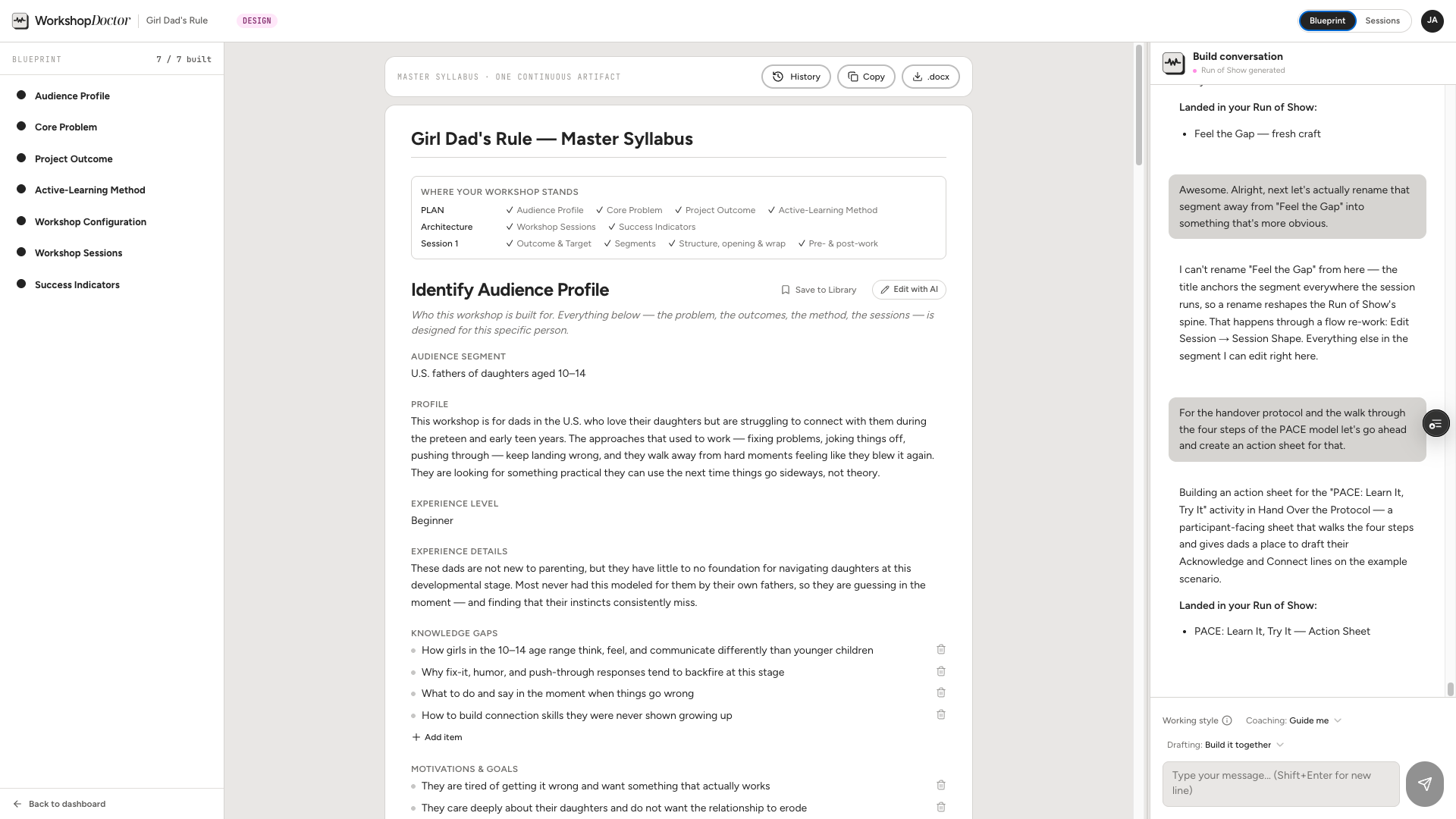
The first decision is determining how narrow your audience should be.
Stay too wide and there is no problem specific enough to solve. CREATE helps you find the sweet spot.
Once the audience is narrow enough, the problem can be named, the skill can be built, and what success looks like can be proven.
Our advanced AI is there for every one of those decisions, trained on the method and on your workshop.
By the end, you receive a complete blueprint.
Every session is mapped. Every activity is built around your clients attempting the specific skill that drives behavior change, instead of just hearing about it.
The blueprint that's created becomes your run of show. From beginning to end, every detail of your workshop is in its place.
When it's time for the workshop session to go live, every one of those details is already there and ready to use.
STAGE
Your attention goes to your clients, not the controls
Think about what delivering looks like right now in meeting software like Zoom, Meet, or WebEx.
- Slides in one window.
- Your agenda and notes somewhere else.
- A timer running on your phone.
- Breakout rooms that open without interactive docs.
- The need for third-party extensions that help create more interaction.
- And half your attention spent working the controls instead of reading the room.
That's the virtual setup. But what about the in-person or IRL (in real life) workshops?
- Everybody gets a paper-based workbook, but you can never see their work.
- You run polls and surveys, but you can't attribute responses to each individual.
- Whenever you launch breakouts, you can't follow or capture what the groups are saying.
- The energy in the room feels good, but you have no idea if what you taught truly landed.
STAGE ends all of that.
What you finished in CREATE is what runs on STAGE. You do not make the slides again, or the polls, or the assessments. They are already there.
You open the session. Your notes are in front of you. You move to the next thing on the agenda, and what your clients see changes with you.
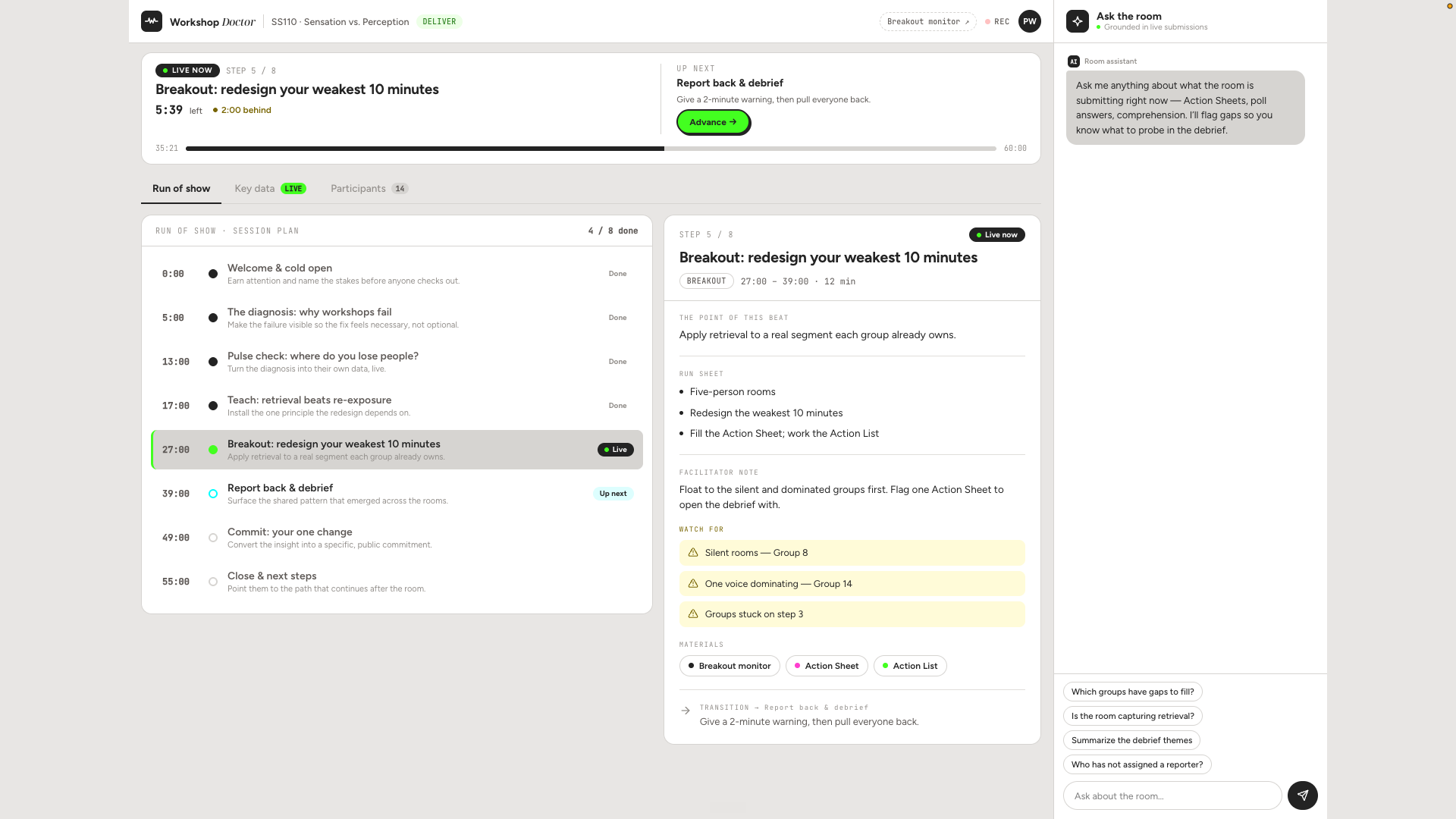
Your clients go to work on the skill, not through a lecture. When someone hits a problem, you can pull it up on screen and begin coaching on something real.
When they work in groups, the breakout rooms open already loaded with the task. Groups start working instead of asking what they were supposed to do.
STAGE records everything. Every action is tied to the person who did it.
Each individual has a dedicated learning profile: what they did, and whether it met the outcome you set.
Whether virtual or in-person, STAGE organizes the session and simplifies the delivery, so the only job left in the room is coaching your clients towards developing the skill your offer promises to deliver on.
Next, you ensure that's taking place with EVALUATE.
EVALUATE
Now you can show what changed, and exactly what to sharpen next
Think about how workshops get measured today.
A form before the day starts: who they are, what they do, what they want out of it.
A survey after it ends: how it went, what they liked, whether they would recommend it.
That tells you who was in the session and how the day felt.
It does not tell you what your clients can do now that they could not do before.
And that is the part you promised them.
EVALUATE reads the session against the design.
CREATE already named what your clients should walk out able to do. Not topics. Outcomes.
STAGE already recorded what they could actually do.
EVALUATE puts those two next to each other.
What changed, outcome by outcome, against what your design promises.
Client by client, and across everyone in the session.
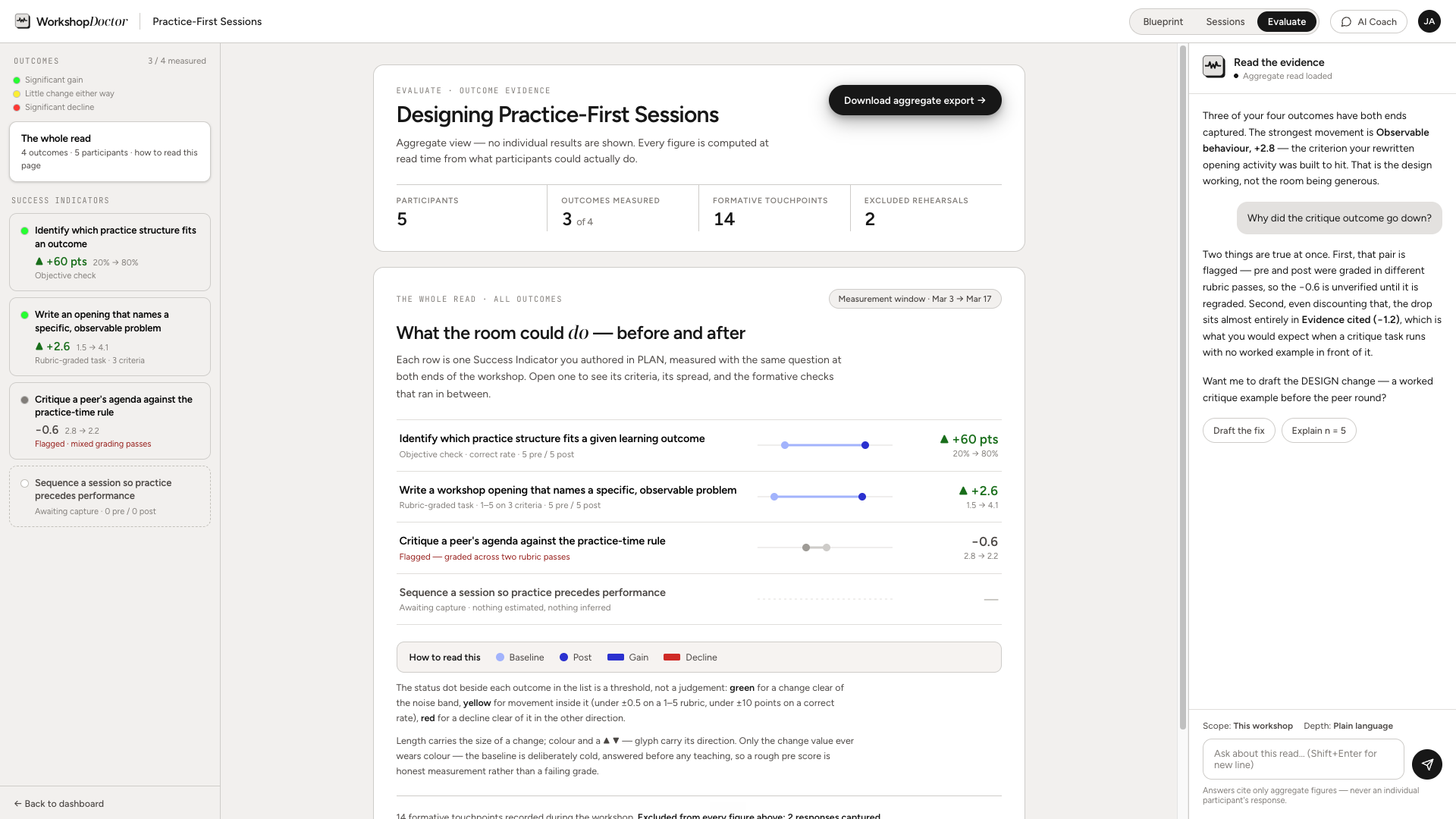
That one comparison does two jobs at once.
It is proof you can hand to the person who paid for it.
And it gives you the exact list of what to sharpen before you run it again.
You do not have to guess whether your workshop worked.
You can show it.
Which means you can now keep every promise your offer makes.
But is this the right fit for you right now?
Let's be direct about both sides.
STUDIO IS NOT FOR YOU IF
You're married to the traditional format — the expert at the center, delivering what they know. Everything we build points the other way: at what your clients walk out able to do.
You don't have specialized expertise — the insight necessary to properly coach a room, and navigate real-time problems that an individual may have. Removing a presentation will expose you.
You are more concerned with status — the appeal of being the expert is more important than generating more skill for your clients and audience. This is out of alignment with our mission.
STUDIO IS FOR YOU IF
You run an established education business doing $300k a year or more. Workshops carry real weight in your business and are a core part of your client-based offer.
You want your workshops built properly — grounded in learning science, measured against results — without giving it a year of your own hours.
You are dedicated to doing the right kind of work. You are interested in making strategic improvements that benefit you and your clients.
If you believe this is for you, here's what really matters...
What we build together changes what you do in the room.
The design puts your clients to work, which means less of the session is you talking. That's a real change, and it isn't a technique adjustment.
You cannot be a poser in this approach.
Talking less doesn't mean knowing less. It means seeing a gap open in front of you and coaching a room through it in real time, without a slide to hide behind.
That's harder than presenting, not easier — and if you genuinely know your field, it shows it more clearly than the old model ever did.
If you are a good fit and want to move forward, it starts here
For full transparency, September 2026 marks the launch of this platform and service. As such, we are being very selective with who we work with.
If you qualify and want to move forward as one of our founding clients, it's imperative that you understand that you will be helping us to iterate and improve on the platform during these early stages.
Even though there will be some pricing incentives for being an early adopter, this will not be cheap. The combination of resources that we provide mandates and merits that this be more expensive than other platform tools that don't provide the integrated system we've built or the level of support and service to ensure your success.
Committing to moving your entire workshop business onto a new ecosystem and platform is no small decision. Consider it carefully before applying. We only want to move forward with those who are treating this opportunity like we are… A long-term relationship where everybody wins.
THE APPLICATION
Here are your next steps
Click the link below and honestly answer a few qualifying questions.
Receive an immediate response.
If it's a no, we'll tell you why. If it's a yes, next steps will be provided.